


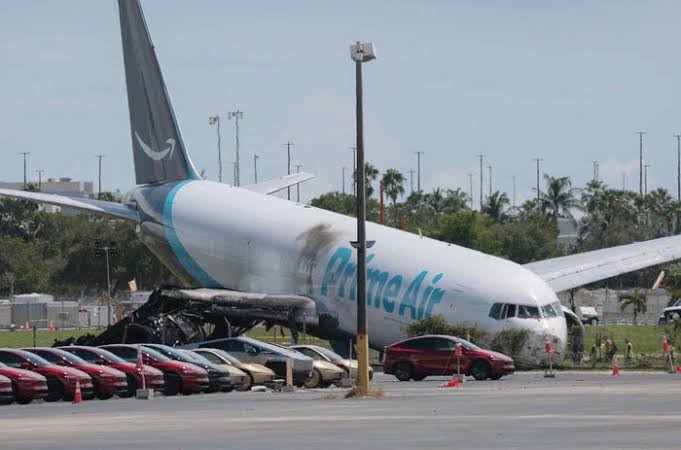
Five people are dead and five more are recovering from injuries after a Boeing 767 cargo jet flying for Amazon's delivery network shot past the end of a runway while landing at Miami International Airport, tearing through a fence and slamming into vehicles parked nearby. The crash unfolded in broad daylight Sunday afternoon, sending a column of black smoke over the airfield and drawing one of the largest emergency responses South Florida has seen at its main airport in years.
Federal aviation officials say the aircraft, operating as Flight 7598 for 21 Air on behalf of Amazon's Prime Air cargo network, was arriving from San Juan, Puerto Rico, when it touched down on Runway 30 shortly before 2 p.m. Rather than slowing to a stop, the plane kept rolling well past the runway's end, crossed a grassy buffer zone and burst through a security fence before coming to rest in a field near the airport's perimeter.
Miami-Dade Fire Rescue's chief said crews arrived to find intense flames concentrated around the plane's engines, along with a chaotic rescue scene involving both crew members trapped inside the cockpit and civilians pinned inside two vehicles the aircraft struck as it skidded off the pavement. Roughly 200 firefighters and more than 60 emergency units responded, and specialized rescue teams had to cut victims free from the wreckage.
County officials said three of the five injured survivors remain in critical condition, while two others were treated for less severe injuries. Authorities have not yet released the names of those killed or hurt, and it remains unclear how many of the fatalities were aboard the aircraft versus on the ground.
Federal Investigators Piece Together What Went Wrong
A National Transportation Safety Board team arrived in Miami within a day of the crash and has begun the painstaking process of documenting the scene before evidence deteriorates. The agency's chair told reporters the crash site left a lasting impression and confirmed that the plane's flight data and cockpit voice recorders have already been recovered for analysis.
Investigators disclosed that the aircraft clipped a van carrying seven occupants that was operating inside the airport's secure perimeter, then continued on to strike a second vehicle, an SUV, positioned just outside the airport boundary. Tracking data reviewed by aviation analysts suggests the jet was still traveling close to 130 miles per hour by the time it reached the end of the runway, well above a typical landing speed at that point in the rollout.
Aviation experts say investigators will likely focus on four broad areas as they work to determine a cause: how the aircraft was piloted during its final approach, conditions on the airfield itself, the weather at the time of landing, and the mechanical condition of the plane. Notably, no emergency distress call was made to air traffic controllers before touchdown, suggesting any problem may have surfaced only in the final seconds before the wheels hit the runway.
The crash has also renewed scrutiny of runway safety technology at Miami International, since the airport's runways are not fitted with engineered arrestor systems — beds of crushable material designed to physically stop an overrunning aircraft before it reaches the perimeter fence. Some U.S. airports have adopted the technology following past runway excursions, and the absence of such systems at one of the country's busiest international gateways is expected to become a focal point of the investigation.
Airport Operations Disrupted on a Holiday Travel Weekend
The crash forced Miami International Airport to operate on just two of its four runways during one of the busiest travel stretches of the year, triggering a wave of delays and cancellations that stranded holiday travelers well into the following day. Passengers interviewed at the terminal described a mix of frustration over disrupted plans and somber reflection on the loss of life that had unfolded just hours earlier on airport grounds.
Responsibility for the crash will ultimately fall to the aircraft's operator, 21 Air, under standard federal aviation rules governing cargo carriers. Aviation analysts have pointed out that 21 Air effectively grew out of Atlas Air's cargo operations, the same carrier involved in a fatal 2019 crash of a similar Boeing 767 cargo jet in Texas — an accident federal investigators ultimately attributed to pilot error and gaps in training procedures.
Amazon has not detailed what role, if any, its own safety oversight played in the flight, since Prime Air relies on contracted carriers like 21 Air to operate its cargo fleet rather than flying the routes itself. The NTSB's full investigation is expected to take months, but officials say a preliminary report outlining early findings could arrive within weeks.
For now, the crash stands as one of the deadliest ground-level aviation accidents at a major U.S. airport in recent memory, and it has reopened a broader conversation about runway safety infrastructure, cargo-carrier oversight, and how quickly high-traffic airports like Miami International can recover normal operations after a catastrophic incident.